Thursday, April 17, 2014

Gentrification in Silicon Valley (Blog 8)

The idea of technology affecting our everyday lives is something at the core of our work in this class. While many consider the internet and technology to be a separated entity, but in fact it is deeply tied to the world we live in.

Recently we discussed Gentrification, the social practice of communities shifting towards higher wealth and social standing at the expense of those left behind in the dust. In fact, there is a real-world example of this happening very recently, one that exemplifies this idea of Gentrification.

Ok so maybe it's not the REAL google campus
Google is a very big company right now. They own YouTube, Android, and have their fingers in countless other projects and companies in the technological world. Most people have a pretty high opinion of Google. I mean, they gave us the most popular search engine in the world, one of the best mobile phone platforms out there, and some of the fastest internet speeds available right now. But in San Fransisco, Google is guilty of gentrification in regards to their new campus. Protesters actually stopped a Google Bus on it's way to the campus due to the shady methods in which Google had acquired and managed their new housing buildings. As a result of Google's acquisition of a new campus in San Fransisco, buildings in the surrounding region were seized (potentially illegally, according to some SF sources), and the community living in the areas evicted and cast out in favor of the new, wealthy Google residents. This kind of exodus of native people from their home in lieu of a newer, wealthier power is the kind of thing that Drori warns us about in regards to gentrification. The city of San Fransisco, pleased to let this new power come in and raise the wealth and social standing of the community turns a blind eye to the shady practices of the company, at the cost of the well-being of its existing residents.


Wednesday, April 16, 2014

Making Stuff Cheap (Blog 10)

America - Chinese Made

Who produces goods for the U.S. market and where?
As we observed in "Mardi Gras," the majority of goods sold in the US market are made pretty much anywhere but the US. Many of our products are made in China, or some other Asian country by workers likely being paid far too little for the work they are doing. 

Why do more and more U.S. companies manufacture and source products overseas, and why do U.S. consumers purchase these products? 
US companies manufacture products overseas primarily to cut costs. As we saw in "Mardi Gras," the owners of the bead company claimed that US workers were simply too costly to meet the demands that US consumers have. Because we've come to expect a certain low price on many products, we've created a market where US companies have little choice but to outsource labor to somewhere that is willing to be paid far less than they ought to. We buy these products mostly because we don't actually care about where they come from. As in the documentary, many people were obviously bothered by the facts of where their beads came from, but none of the party-goers actually cared enough to give more than a few moments thought to the issue.

What are the working conditions at foreign factories producing goods for the U.S. market?  
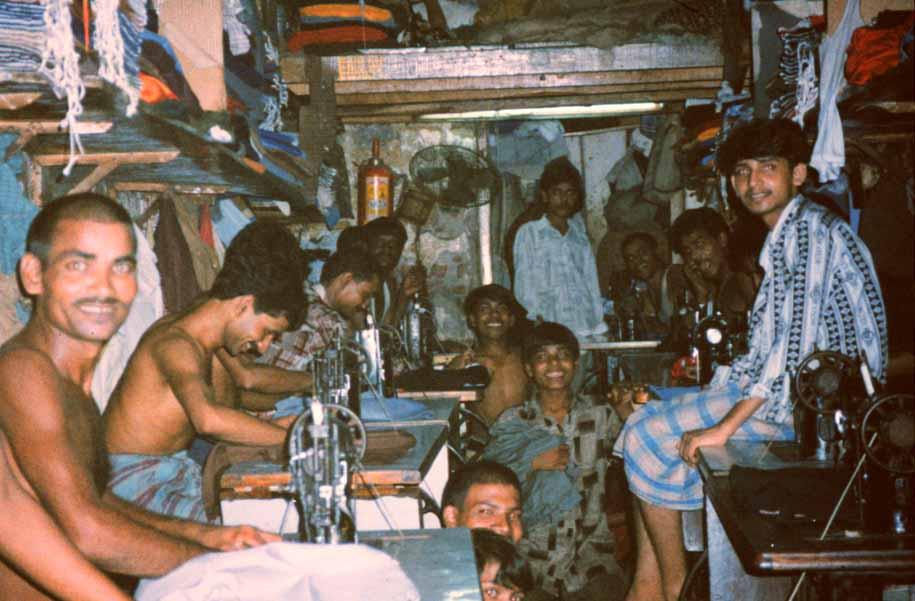
In a word, bad. Many factories in foreign countries are poorly maintained, allowing the workers only the comforts they absolutely need to make them stay employed. The bead factory in the documentary was reminiscent of a terrible summer camp to be honest, and the factory floor was obviously terrible for the workers' health.

Don't they look so happy?

Why do factory workers in foreign factories work under the current conditions?  
Most of the time it is because they have little choice. Especially in Asian countries, if you cannot make it in school you have pretty much no future in a decent-paying job, and often times families cannot afford to put more than one of their children through a good school. Many workers at these factories are teens who were either fed up with school life and wanting to work, or come from poor families who were unable to put them through school for one reason or another. Additionally, these foreign factories are, surprisingly, a good source of employment for these workers, who's prospects otherwise would be similar or even more dim.

What are the economic and social impacts of globalization?
As stated before, economically speaking, globalization and the expectations of Western consumers has engaged in sort of a viscous cycle. Companies are unable to turn to Western workers because of production costs, and consumers won't allow the price hike that would come along with those production costs. As a result as well, Western money that probably should be going to their own countries is being sent overseas to workers who are willing to do the labor at a cheaper price.
  

Embodiment - Bodies in Cyberspace (Blog 5)

One of the biggest draws of the internet is also one of its biggest concerns, and that is the supposed erasure of self online. When you log onto the internet, nobody can see you, and as such, we all take on a kind of internet body when we go online. However, this idea can lead to many difficulties, especially for people of color.

In a way, the internet is very much a vehicle of pop culture. Take the image to the left. Memes like this are one of the most common things on the internet, because they're popular. Online, popular content is king, and shapes the way we view content, as well as people. Especially in Western society, we consider white males to be the largest demographic. Since the west is the region of the world that tends to have the largest user base on the internet, we allow our preconceptions of the typical race and gender of Western citizens to shape our embodiment of the online self. But as I said before, pop culture also plays into this image. In Marez's article on Star Wars, we see how George Lucas' depiction of Tatooine as a farming region populated purely by whites counters the racial struggles being experienced at the time by Cesar Chavez and United Farm Workers. While it may not have been Lucas' intention, his depiction of farm workers as white in popular culture shifted the embodiment of farm labor to a white domination, in much the same was as our preconceptions of race and gender in internet-using countries subconsciously affects our embodiment of the online self.

Because of these preconceptions, we see the embodiment of the internet user as a white male, which causes problems online for both people of color as well as women. In Hawthorn's essay, he argues against the male-dominated internet culture that allows exploitation of women and children, claiming that we cannot allow our internet to be dominated by these kinds of male-born creations. In a way, the internet is very much a vehicle of human vice. Because we consider everyone online to be the same, to be a faceless being, we allow our vices to get away from us, hiding behind the veil of anonymity. The exploitation of women also shows how we view the balance of power in society. Because the internet can be viewed as an unfiltered look into the true makeup of society, the fact that it is considered to be completely male-dominant betrays the supposition that men hold all the power in society, and women are meant to be subservient.

Blog 4 - The World in WWW

In the digital age, globalization is a word that is often tossed around, in a wide variety of cases. In general, we understand globalization to be a force that slowly spreads ideas around the world to the benefit of everyone, but is there more to it than that? After our readings and the viewing of the "Office Tigers" documentary, I would say so.

Oh, globalization

"Office Tigers" takes a look at the globalization of a tech support company, but instead paints us a picture of a new wave of imperialism. In the documentary, it was plain to see that, much like the colonization of old, white man came to a foreign land and taught the locals to do their bidding. While not as extreme an example, the operation of the company Office Tiger is shockingly similar to this ancient practice. Engaging the ideas brought up by Shome in his article, Office Tiger is an example of Asian outsourcing, a practice becoming all too common in the technologically driven world.


The issues of Shome's proposed new kind of racial disconnect is apparent in the documentary as Indian workers are required to cater specifically to western needs and constructs, much as the call centers in Shome's research must deal with the issue of white pandering and aural discrimination. In a way, all outsourcing causes this problem of racial disconnect and dissatisfaction, as western companies turn to Asia for cheaper labor, but western consumers expect western support.

Another issue evident in this key example of outsourcing is the problems that arise from the digital divide. Though India is in no way poor, the imperialistic companies introduce new technologies that the Asian workers are ill equipped to deal with, further complicating the issues of racial and locational disconnection.

Friday, February 7, 2014

Blog 3 - My Filter Bubble

     I remember back when the issue of filter bubbles started being a big deal, or at least started being a big deal in my circle of friends. In middle school we started noticing that on GMail, Google would place specific ads based on our emails or search history. Then Facebook started doing it a few years later, and now I guess everyone's doing it. I think the real concern with the idea of the filter bubble nowadays, a whole three years after Pariser's TED Talk, is that the filters really have kind of completely taken over the web.

     Google uses your information to give you more options that are similar to what you already search, Facebook filters out posts that it thinks you don't have interest in, even on our smartphones there are filters set up that are made to pander to what an algorithm thinks we want to hear. This is different from a self-initiated filter, and concerning, because we have no say in the matter, or at the very least we're required to jump through a lot of hoops in order to disable this kind of filter. In the example of Facebook, Pariser suggests that we opt to keep our data private, but Facebook doesn't really want you to do that, and makes it kind of hard. I don't even think you CAN stop Google from customizing your search options.

     The other problem with this kind of filtered society we live in is that it's almost a necessary one. In one of my other classes we've been studying the idea of a "participatory culture" on the web, meaning that everyone gets a chance to author and participate in the creation of information. This is largely a good thing, but at the same time, it's the root cause of the web filter mentality. If you have naught but intelligent, well-meaning friends on Facebook, then at the worst, Facebook is removing valuable and different opinions as Pariser stated in his own personal example. But let's look at the typical demographic of Facebook users. Most of them are teenagers, and they have a lot of friends. And I mean a lot. I doubt anyone actually has 500+ friends in real life that they care about and talk to, it's just not realistic, but lots of facebook users have incredible amounts of friends. Unfortunately, not all of those friends are going to have something interesting and important to say. In fact, I would be willing to bet that a large majority of them have pretty stupid, asinine commentary. Those people are ones I don't care about. I WANT their crap out of my feed. And there's the problem. In a web so over-saturated with meaningless information, we HAVE to filter to an extent or it's impossible to get any useful information.

     As such, it very much falls to the user to keep filter culture from affecting their lives too greatly. The web can't change itself, at least not for one person, and so I think it's up to individuals to seek out their own information that might be filtered out. It's not the easy road, and in a perfect world, the filters set up would be sophisticated enough to filter information in a more meaningful way, but as it is, there's just no way to block all the crap as well as give you what you need but maybe don't want. Technology isn't that smart.

Blog 2 - Digital Nation: Unflattening our Discourses on Technology

     In Nass' documentary on multitasking, or rather, the illusion of multitasking, he argued that, while an increasing number of people, especially in the college demographic, believe themselves to be quite adept at the art of multitasking, that is, focusing on many different things at once, an idea brought on by our increasingly digital era, where every student has a phone, ipod, computer, etc running at the same time, these people are often not as skilled as they might like, and in fact, this multitasking society that we have created may slowly be killing our ability to think critically and work efficiently.

     Personally, I think this viewpoint is a little reactionary. Certainly the science behind what Nass was arguing is valid. A person is always going to be at their most efficient when they are focusing on one thing and one thing alone. However, this method of doing things doesn't work in the real world anymore.

      In a lot of ways, technology, and the ability it gives us to do multiple things at once, is a huge benefit to society. Take this picture above. The person here has facebook on their computer and twitter on their phone. Nass would probably argue that this kind of thing only limits our ability to do either task efficiently, but I personally disagree. I think it depends on what is meant by "efficiency." If you're on facebook on your laptop, and you want to tweet something, you'd have to open a new tab (or new window if you're stuck in the 90's), log into twitter, tweet whatever it is, and then migrate back to facebook and resume whatever you were doing there. Sure that whole exchange probably takes like 25 seconds, but still. If you have these apps on your phone, you can leave facebook up on your computer, pull up twitter on your phone, keep looking at facebook while it loads, jot down your tweet, and then resume what your were doing on your laptop, never really losing focus on either thing.

     This idea relates a lot to the idea of what Nass described as "entertaining ourselves to death." His standpoint was that we're so wired and constantly looking at so many different things: Twitter, Facebook, Tumblr, Blogger, Email, Texts, etc, that we can't possibly focus on the important matters in life. Moving into the theory of "Always On," I think this idea, that people today are always on some kind of networked device, is the core to debunking the idea of entertaining ourselves to death. If someone from, say, the 19th Century, whose only forms of information were books, and whose only forms of communication were literally talking to someone or sending a letter, were suddenly thrust into our society and given a cell phone, this idea of being entertained to death would be valid. The poor guy would be overwhelmed with the novelty and efficiency of this new power, and would likely lose sight of real life.

What am I supposed to DO with this thing?

     However, people today are born into this kind of always on world, and are exposed to the veritable smorgasbord of technology that surrounds us from day one. As such, while it certainly does affect our ability to do certain things, the constant use of technology we have is far from debilitating to the point of killing us.

Blog 1 - Why Study The Internet

     In outlining the necessary steps in order to analyze the web in a Sphere, Foot professes the need to archive information presented to us. While his methodology does not actually include social networking, I believe it would be possible, and indeed perhaps quite simple, to include social media sites in this sort of web sphere analysis.

    Upon taking this sort of task on, one might think the idea of archiving all the interactions amongst users, especially on a social networking site, to be a daunting, if not impossible task. But is it really any different than trying to archive the interactions between people elsewhere? Just because these sites see a greater degree of traffic than others, and certainly more interaction, does that really make it less likely for us as analysts to archive the goings on between people? I think not.

     In fact, the mere nature of the social media networks, such as Facebook or Twitter, make it easier than it would be otherwise to monitor the interactions between people and the "bits of content," as Foot describes them. As an example, let's look at a typical Twitter post:

 
       Ignore the content, but let's look at what information it gives us. Not only does the post impart the information the user was getting at, we have two other important bits of data that are very conducive to Web Sphere Analysis. One of those is the hashtag. By itself this is a pretty meaningless phrase, but the nature of hashtags is that they spread, and many users end up adding them. In this way, we have a built in way of tracking the flow of similar thoughts and the passage of specific "bits of data," without having to do practically any work. Second, we can see at the bottom who's "retweeted" the post, another way of allowing us to easily see the flow of site-based interaction.

     In Foot's study of 9-11, he found that personal sites were the most allowing of expression of both types. If we were to do a similar study, using the Boston Marathon Bombing, and including Social Networking sites, I anticipate that the primary location of either type of expression would shift to networking locations, specifically Facebook and Twitter. These types of sites have somewhat replaced personal sites for uses of expressing one's opinion. Why take the time to create and author a blog about your opinion when you can reach a wider audience with ease on a social media site?

Wednesday, January 22, 2014

An Introduction to Me

Hey there! My name is Spencer Scott, and I'm a DTC and Art major here at Washington State. I won't give you all my whole life story since that would probably be pretty boring, so I'll keep it short and sweet.

I like to think of myself as an artist first and foremost, it's been my passion in life ever since I was like ten years old, so I have a long history with art. When I came to college, I decided to pick DTC as a major because I figured it would be a good middle ground between what I love, art, and being practical with picking a major that would actually get me a job. Later though I decided that dreams aren't all worth just giving up, so I'm persevering through a second major in order to get a BFA as well as my Bachelor's in DTC.

Other than drawing, which I try to do a lot of when I can (I'm working on a couple big projects with my own characters and stuff), I would say my second biggest passion is music, more specifically listening to it. I'm somewhat of an amateur audiophile, and I've spent probably more money than I should have on various high-quality audio equipments. Apart from that, I'm somewhat of a gamer, mostly casual though I play competitively with friends on occasion, and I guess my other biggest hobby would be sleep haha.

As I mentioned, I'm a DTC major, so therein lies the motivation behind me taking this class. That said, I'm actually looking forward to this one, it seems like it should be pretty interesting and I'm excited to see what a look into digital diversity can teach me over the course of this semester!